There’s a reason people pay close attention when a company like Tesla starts running self-driving taxis on public roads. The promise is enormous — no driver, no human error, just software navigating the city while you sit back. But when something goes wrong, the questions that follow are just as enormous. What actually happened? Who was at fault? And is this technology genuinely ready?
For months, Tesla had been filing crash reports with federal safety regulators while simultaneously keeping the details hidden behind confidentiality claims. That changed recently. The company agreed to unredact its incident data — and what came out paints a more nuanced picture than either Tesla’s critics or defenders might have expected.
How Tesla’s Robotaxi Program Got Started
Tesla launched its robotaxi service in Austin, Texas, in June 2025. It started quietly — a small pilot, a select group of invited riders, a fleet of 2026 Model Y vehicles operating with an autonomous driving system and a human safety monitor seated behind the wheel.
The rollout was deliberately narrow. From a distance, it looked cautious. Up close, it still does. Based on crowdsourced data from independent trackers who reverse-engineered Tesla’s ride-hailing app, the company was operating approximately 35 vehicles in Austin some nine months after launch — and availability remained low, often below 20%.
That’s a strikingly small fleet for a company that had spent years telling the world full autonomy was just around the corner. But Tesla’s own leadership has since acknowledged that the company is being deliberate. Elon Musk himself stated publicly that ensuring complete safety is the single biggest constraint on expanding the network.
What the Crash Data Actually Shows
All self-driving car companies operating in the United States are required by law to submit crash reports to the National Highway Traffic Safety Administration (NHTSA). Most companies — Waymo, Zoox, Aurora — include detailed written descriptions of each incident. Tesla had been doing the opposite: submitting the reports but blacking out every narrative, labeling them as confidential business information.
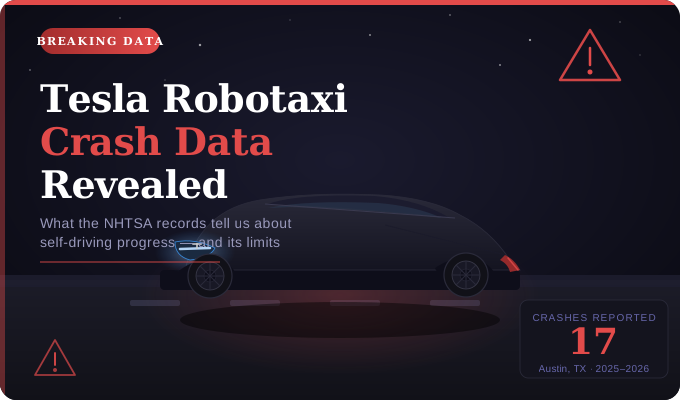
That changed recently when Tesla agreed to unredact the data. The newly available records provide the first detailed look at all 17 incidents recorded during Tesla’s Robotaxi testing program in Austin, covering the period from July 2025 through March 2026. Every incident involved a 2026 Model Y with the autonomous driving system engaged and a human safety monitor present.
The injury picture is relatively mild. Thirteen incidents resulted in property damage only, two had no injuries at all, one involved a minor injury that didn’t require hospitalization, and one — the most serious — resulted in a minor injury that did require hospital treatment.
So no fatalities. No major injuries. But the details behind specific crashes raise real questions about where the technology still struggles.
When the Remote Operator Made Things Worse
Perhaps the most attention-grabbing detail in the newly released data involves crashes that happened not because of the autonomous system itself — but because of the remote human operators brought in to help.
Tesla operates with what it calls “teleoperators” — remote workers who can take control of a robotaxi when the onboard system runs into trouble. The company has told lawmakers that these operators are only authorized to pilot vehicles at speeds below 10 miles per hour, and only to reposition vehicles that are stuck or blocking traffic.
In July 2025, shortly after Tesla first started operating the network in Austin, the automated driving system had trouble moving forward while stopped on a street. The safety monitor requested help from Tesla’s remote assistance team, and a teleoperator took over vehicle control — then drove the car up a curb and into a metal fence.
A similar sequence played out in January 2026. The Tesla automated system was driving the vehicle when the safety monitor requested support for navigation. A teleoperator took control and ended up driving the car into a temporary construction barricade at approximately 9 miles per hour.
In both cases, no passengers were on board and the crashes happened at low speeds. But the underlying point is hard to ignore: the system called in a human for help, and the human made the situation worse. That’s not a flaw unique to Tesla — remote operation is genuinely difficult — but it’s a real limitation that the unredacted data now confirms on record.
What the Self-Driving System Got Wrong on Its Own
Beyond the teleoperator incidents, the crash records show a few patterns where Tesla’s autonomous system itself struggled.
In one September 2025 crash, the system drove into a metal chain while entering a parking lot after making an unprotected left turn. In October, the autonomous system clipped a dump trailer’s gooseneck hitch that was sticking out into the street. In January, it backed into a wooden electrical pole, and in another January incident, it hit a curb while reversing into a parking space.
There was also an unusual moment: in September 2025, one robotaxi struck a dog that darted into the roadway — though the dog was reported to have run away afterward.
These kinds of incidents reveal a gap that’s well known in the autonomous driving world. Software that handles highway driving or open roads with predictable geometry can still struggle with the messy, unpredictable details of urban environments — tight parking lots, partially obstructed lanes, animals crossing unexpectedly. The real world doesn’t follow a script, and that’s exactly where autonomous systems tend to show their limits.
Crashes That Weren’t Tesla’s Fault
Here’s where the picture gets more balanced. A significant portion of the 17 incidents weren’t caused by Tesla’s system at all. Many crashes happened while Tesla vehicles were stationary, waiting at traffic lights, stop signs, or in slow traffic. In multiple cases, other road users struck the autonomous vehicle from behind or clipped it while passing. Incidents included a truck rear-ending a stopped Tesla, a city bus sideswiping it during a turn, and a pedicab hitting one of its mirrors.
This is actually a known pattern across the entire autonomous vehicle industry. When you have a vehicle that obeys traffic laws consistently — stopping fully at stop signs, not rolling through yellow lights, maintaining following distances — human drivers around it sometimes behave unexpectedly. Being rear-ended while legally stopped at a red light says more about the human driver behind than about the autonomous system.
Still, even accounting for that, the overall crash rate context is worth sitting with. Based on available estimates, Tesla’s fleet was experiencing roughly one crash every 57,000 miles — compared to approximately one crash every 500,000 miles for the average American driver, according to NHTSA data. Tesla has not regularly shared mileage figures, which makes precise comparison difficult, but the gap is significant enough to warrant continued scrutiny.
How Tesla Compares to Waymo
Any honest look at Tesla’s self-driving ride program has to reckon with Waymo, which is currently the most mature commercial robotaxi operation in the United States.
Waymo operates over 2,500 fully driverless robotaxis across multiple U.S. cities with no safety monitor in any vehicle. The company has logged over 127 million autonomous miles, and independent research published in peer-reviewed journals shows Waymo’s crash rate is 85% lower than human drivers for injury-causing incidents.
Tesla, by contrast, is operating roughly 35 cars in one city — every single one with a safety monitor on board. That’s not a comparison of equals. It’s a comparison of a program in early testing to one that’s been scaling commercially for years.
What Tesla has that Waymo doesn’t is scale in a different direction: millions of consumer vehicles already on the road collecting real-world driving data. The question is whether that data advantage will eventually translate into a safer autonomous system. That’s Tesla’s core bet — and the Austin data is one early indication of how that bet is playing out.
Why the Slow Progress Makes Sense
When you step back from the individual crash reports and look at the broader picture, the slow pace of Tesla’s robotaxi expansion starts to make practical sense — even if it contradicts the timelines the company had been projecting for years.
Self-driving in controlled conditions is a solved problem in many ways. The hard part is edge cases: the dog in the street, the construction barricade, the teleoperator who makes the wrong call, the chain strung across a parking lot entrance. These are exactly the kinds of things that don’t show up in testing environments but do show up in real cities with real unpredictability.
Only weeks after the service debuted in Austin, the NHTSA said it was investigating several incidents in which the robotaxis were filmed driving erratically, including driving down the wrong side of the road and braking suddenly. That kind of early-stage behavior is not unusual in autonomous vehicle testing — but it does underscore why a cautious rollout is the right call.
According to analyst projections, Tesla plans to launch robotaxis in seven U.S. cities in the first half of 2026, with hopes to reach half of U.S. states by year-end. Whether those targets hold will depend on what the data continues to show — and now that Tesla has agreed to release that data in readable form, the public can follow along in real time.
What This Means for the Future of Self-Driving Rides
The Tesla robotaxi story isn’t a simple success or failure. It’s more like an ongoing engineering experiment conducted in public — which is both what makes it valuable and what makes it uncomfortable.
From a practical standpoint, the 17 incidents over roughly nine months of limited testing in one city don’t signal a catastrophic safety problem. Most crashes were minor. Many weren’t caused by the autonomous system at all. But the teleoperator incidents, the parking lot struggles, and the relatively high crash rate per mile compared to human drivers all suggest that there’s meaningful work still to be done before this technology is ready for wide, unsupervised deployment.
In real-world testing environments, this is normal. Every complex technology goes through a phase where its limits become visible before its reliability becomes dependable. The difference with self-driving cars is that those limits play out on public roads, involving real people, and the stakes of getting it wrong are higher than most other product categories.
For now, Tesla’s robotaxi program is best understood as a serious, cautious attempt to close the gap between what the software can do in a lab and what it needs to do on every city street in America. The newly released crash data doesn’t end that story — it just finally lets everyone read it clearly.
This article is for informational purposes only and is based on publicly available data from NHTSA filings and reported media sources. It does not constitute safety or investment advice.