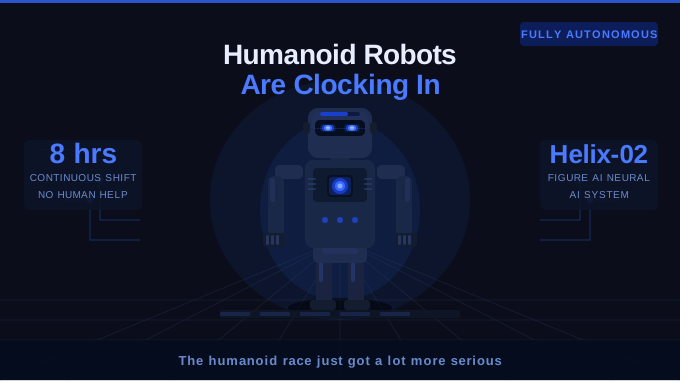
There’s a moment when a technology stops being a demo and starts being real. For humanoid robots, that moment may have arrived on May 13, 2026 — when a team of Figure AI’s robots completed a continuous, fully autonomous eight-hour factory shift without a single human stepping in to fix, reset, or supervise them.
No remote operator. No hand-holding. Just robots, working a full shift the way a human would.
That’s not a small thing. That’s a signal.
What Figure AI’s Helix-02 Actually Did
To understand why this matters, it helps to know what the robots were actually doing — because it wasn’t just standing around looking impressive.
Figure AI’s Figure 03 robots, powered by their in-house AI system called Helix-02, were placed on a package-sorting conveyor belt. Each robot had to detect a barcode on an incoming package, pick it up, reorient it so the barcode faced down, and place it correctly on the belt. Over and over, for eight hours straight.
What makes this genuinely interesting isn’t just the duration. It’s the reasoning involved. The robots were working purely from camera pixels — no special markers, no guided tracks, no simplifications. They had to figure out where each package was, how it was oriented, and what to do with it, all in real time.
Figure AI confirmed the robots were matching human performance, averaging around the same processing speed as a human worker doing the same task — approximately three seconds per package.
Even more notable: the robots were networked together and communicating with each other to maximize conveyor uptime, designed to run without interruption. This isn’t one robot performing well in isolation. It’s a coordinated system — closer to how a real warehouse or factory floor actually operates.
The Technology Behind Helix-02
Most people hear “robot AI” and picture something like a chess computer — rigid, programmed for one thing, brittle outside that scenario. Helix-02 is fundamentally different in how it’s designed.
Traditional industrial robots — the kind you see welding car parts or moving items on assembly lines — typically run on separate control systems. One system handles movement, another handles the manipulation of objects. These systems don’t talk to each other naturally. The robot has to switch between them, which creates delays and limits what it can do in dynamic, unpredictable environments.
Helix-02 integrates both movement and manipulation into a single neural network, processing all inputs simultaneously — including vision data from cameras on the head and palms, tactile sensors on the fingertips, and joint position data from across the entire body.
The result is a robot that moves and acts more like a coherent system, rather than a collection of parts trying to coordinate.
Figure AI also introduced what they call “System 0” — a learned whole-body controller trained on over 1,000 hours of human motion data, replacing more than 109,000 lines of hand-engineered C++ code with a neural control system capable of maintaining stable, human-like motion.
That last detail deserves a moment of attention. Hand-coded motion logic is notoriously fragile. It works well in the exact scenarios it was designed for, and poorly everywhere else. A learned system, trained on real human movement, can generalize. It handles the messy, unpredictable variations of a real working environment far better than scripted logic.
Multi-Robot Coordination and Fine Motor Tasks
The eight-hour shift wasn’t the only thing Helix-02 demonstrated. In earlier tests, Figure showed two robots autonomously resetting a bedroom in under two minutes — hanging clothes, making a bed, taking out trash, and repositioning furniture, all while coordinating around each other without a central controller directing them.
In one kitchen demonstration, a single robot autonomously unloaded and reloaded a dishwasher during four continuous minutes without interruption or resetting — what Figure claims is the longest-horizon autonomous task ever completed by a humanoid robot.
Fine motor tasks have also been part of the testing: unscrewing bottle caps, handling fragile objects, picking small metal parts from cluttered surfaces. These aren’t tasks you program step-by-step. They require real-time sensing and adjustment.
Why an Eight-Hour Shift Changes the Conversation
Here’s the thing about robotics demonstrations: they’re easy to be cynical about. Companies have been showing off impressive robot videos for years, and the gap between a controlled demo and a real industrial deployment has historically been enormous.
What’s different about an eight-hour autonomous shift is that it starts to close that gap in a measurable way.
In real-world industrial settings, the question isn’t “can the robot do the task once?” It’s “can it do it reliably, for hours, across varying inputs, without someone watching over its shoulder?” Endurance matters. Consistency matters.
Figure AI previously reported that its robots completed 10-hour shifts at BMW’s Spartanburg facility, contributing to the movement of more than 90,000 parts and supporting production tied to over 30,000 BMW vehicles. The May 13 demonstration extended that track record in a live, publicly viewable format — broadcast on X for anyone to watch.
That kind of transparency is relatively rare in robotics, where companies often show polished highlight reels rather than unedited footage of hours-long operations.
The Broader Humanoid Race Taking Shape
Figure AI’s progress doesn’t exist in a vacuum. What’s happening in humanoid robotics right now is genuinely competitive, with several serious players making their own moves.
Boston Dynamics Atlas
At CES 2026, Boston Dynamics unveiled the production version of Atlas — fully electric, with 56 degrees of freedom and a 50-kilogram lift capacity — and won CNET’s “Best Robot” award. Every 2026 unit is already committed, shipping to Hyundai’s Robotics Metaplant Application Center and Google DeepMind.
Boston Dynamics is betting on technical capability first, scale second. Atlas has 13 years of continuous development behind it, and the new electric version retains its dynamic agility while adding the reliability needed for real commercial deployment.
Hyundai, Boston Dynamics’ majority shareholder, has committed to a robotics factory capable of producing 30,000 units per year. At an estimated price of $140,000 to $150,000 per unit, Atlas is clearly targeting large industrial customers, not the consumer market.
Apptronik Apollo
Apptronik secured $520 million in funding at a $5 billion valuation, with Apollo robots already operating at partner facilities including Mercedes-Benz, GXO Logistics, and Jabil. Google DeepMind is providing AI capabilities through the Gemini Robotics platform, which gives Apollo a significant edge in terms of underlying AI infrastructure.
From practical observation, what distinguishes Apollo is its focus on modularity and engineering robustness for heavy industrial use. It’s designed to work alongside humans on manufacturing lines — not replace the entire workflow at once, but integrate into it.
Tesla Optimus
Tesla’s Optimus remains the most talked-about humanoid project in terms of public attention, largely because of Elon Musk’s vocal promises about it. In practice, the timeline has shifted repeatedly. Tesla’s prediction of producing 5,000 to 10,000 Optimus robots in 2025 fell significantly short, and at Tesla’s Q4 2025 earnings call, Musk acknowledged that existing units exist primarily for learning rather than productive tasks.
That said, Tesla’s manufacturing scale — if and when Optimus reaches production readiness — would be formidable. The company is converting production lines to manufacture Optimus and has committed substantial capital expenditure to the program. Tesla’s bet is on scale first, capability second.
Chinese Competitors and the Global Dimension
It’s worth noting that the humanoid robot competition isn’t just an American story. Chinese manufacturers have been moving quickly, with companies like Unitree shipping thousands of units and more affordable price points undercutting Western competitors significantly. Unitree’s G1 is available at approximately $13,500 — a fraction of what Atlas costs — though at a very different level of capability.
In April 2026, a Chinese humanoid robot called “Lightning” won the Beijing Half-Marathon in 50:26, outpacing the human world record by nearly seven minutes — a demonstration of how far locomotion and endurance capabilities have come in a short time.
What Remains Genuinely Difficult
It’s worth being honest about what these robots still can’t do well — because that context matters when evaluating the claims being made.
Controlled environments are much easier than real-world chaos. A conveyor belt with barcoded packages is a well-defined problem. A factory floor where item shapes vary, lighting changes, conveyors jam, and unexpected events happen is harder. The open questions around Helix-02 include how it handles packages that are misoriented in unusual ways, how it recovers from failures, and how it performs across a wider range of object types.
Multi-robot coordination across diverse environments is also still being developed. The bedroom reset and kitchen demonstrations were impressive, but both were in environments specifically set up for the demonstration. Generalizing that kind of coordination to arbitrary real-world settings is a problem that hasn’t been fully solved yet.
Finally, the economics of deployment are still being worked out. Even if a robot can perform at human speed, the total cost of deployment — hardware, maintenance, integration, downtime management — has to make sense compared to existing alternatives. That equation is getting closer to favorable, but it’s not universal yet.
What This Means for the Near Future
From everything that’s currently visible in this space, the trajectory is clear: autonomous humanoid robots are moving from research labs and controlled pilots into actual working environments faster than most people expected even two years ago.
The eight-hour shift isn’t proof that humanoid robots are ready to replace human workers across the board. It’s proof that the gap between “impressive demo” and “actually useful in a real setting” is closing — and closing faster than the skeptics predicted.
For manufacturers, logistics operators, and businesses running repetitive, physically demanding tasks, the question is shifting from “will this ever work?” to “when do we start planning for it?” That’s a meaningful change in how the conversation sounds.
And for the broader field of robotics, Figure AI’s latest demonstration adds pressure across the board. When one player demonstrates eight continuous autonomous hours of productive work in a real environment, the entire industry has to respond.
The humanoid race is genuinely on — and it just got a lot more serious.
This article covers developments in industrial robotics and autonomous systems as of May 2026. The field is evolving rapidly; capabilities and deployment numbers may change as companies release updated information.