


If you look back at the last few years, the software industry has felt like a whirlwind of buzzwords. First, it was the “Cloud Migration,” then the “Metaverse,” and recently, the explosion of “Generative AI.”
But as we look toward software companies in 2026, the conversation is shifting. We are moving past the “wow factor” phase and entering the “utility” phase. In real-world business environments, CIOs and managers are no longer just asking, “Is this technology cool?” They are asking, “Does this actually save me money or make my team faster?”
Based on current trajectories and the practical needs of modern enterprises, the software leaders of 2026 won’t just be the ones with the flashiest demos. They will be the ones building the plumbing, the security, and the practical AI tools that run the global economy.
Here is a look at the sectors and specific companies that are positioned to shape the landscape in 2026.
1. The Data “Plumbing” Giants
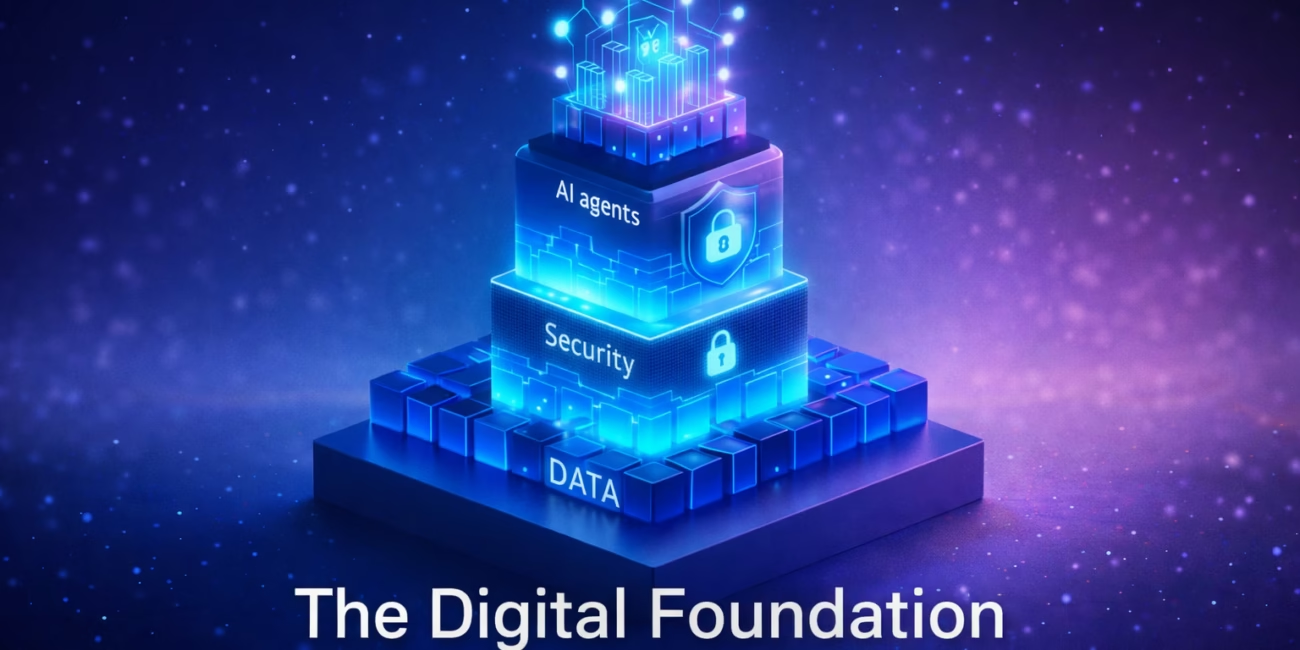
Before any company can run powerful AI, they need clean, accessible data. You can’t build a skyscraper on a swamp, and you can’t build a smart business on messy spreadsheets.
This is why data infrastructure companies are arguably more critical than the AI applications themselves.
- Snowflake & Databricks: These two have been locked in a rivalry for years, but by 2026, their role will be foundational. In practical experience, most large enterprises are moving their disparate data into “Lakehouses” (a mix of data lakes and data warehouses). These platforms allow companies to store massive amounts of raw data and then run AI models directly on top of it.
- Why watch them? As AI moves from “chatbots” to “predictive analytics,” these platforms are the engine room. If they go down, the “smart” features of a business stop working.
2. The “AI-as-a-Co-worker” Pioneers
For a long time, software was something you used—a tool you clicked buttons on. The shift we are seeing now, which will be fully mature by 2026, is software acting as an agent.
- Microsoft (and the Copilot Ecosystem): It is impossible to talk about software companies in 2026 without mentioning Microsoft. By deeply integrating AI into Word, Excel, and Teams, they have made AI boring—in a good way. It’s no longer a novelty; it’s just how you write a report.
- Salesforce: In the world of sales and customer service, Salesforce is pivoting hard toward “autonomous agents.” Imagine software that doesn’t just record a sale, but automatically sends the follow-up email, updates the inventory, and schedules a check-in call without the human rep lifting a finger.
Real-World Context: The difference in 2026 will be trust. In 2024, we checked the AI’s work. By 2026, successful software companies will be the ones that have proven their agents are accurate enough to run unsupervised.
3. The Cybersecurity Shields
The unfortunate side effect of AI and digital transformation is that cyberattacks have become cheaper and more sophisticated. “Deepfake” phishing and automated hacking scripts are real threats.
This makes cybersecurity software recession-proof.
- Palo Alto Networks & CrowdStrike: These companies are moving away from simple antivirus scanners to “AI-driven threat detection.” The only thing faster than an AI hacker is an AI defender.
- Zscaler: As remote work settles into a permanent hybrid model, the old way of securing a corporate network (VPNs) is dying. Zscaler focuses on “Zero Trust” architecture—basically, assuming no one is safe until verified. In a practical sense, this is the future of corporate login screens.
4. The “Unsexy” Efficiency Experts
While consumer apps get the headlines, the backend software that keeps factories and IT departments running is where massive value lies.
- ServiceNow: If you work in a large corporate office, you likely use ServiceNow to fix IT tickets or HR requests. They are quietly becoming the “operating system for work,” automating the messy internal processes that slow big companies down.
- Oracle & SAP: They are often viewed as “legacy” dinosaurs, but they are surprisingly resilient. By moving their massive ERP (Enterprise Resource Planning) systems to the cloud, they remain the backbone of global supply chains. Changing an ERP system is a nightmare, so these companies have incredibly “sticky” customers.
5. The Rise of “Vertical” Software
For a decade, we saw “horizontal” software—tools like Slack or Zoom that everyone uses, regardless of industry. In 2026, the trend is likely shifting toward Vertical SaaS (Software as a Service).
This means software built specifically for one industry.
- Procore (Construction): Instead of using a generic spreadsheet, construction managers use Procore because it understands blueprints and contractor laws.
- Toast (Restaurants): It’s not just a register; it manages kitchen inventory and delivery orders.
Why this matters: General AI is great, but a lawyer needs an AI trained on case law, not internet comments. Specialized software companies that own their specific niche data will likely outperform generic ones.
What to Look for as an Investor or Job Seeker
If you are evaluating software companies in 2026, don’t just look at their growth rate. Look at their “moat.”
- Integration: Does the software play nice with others? The days of “walled gardens” are fading. Companies want tools that connect seamlessly.
- Usage vs. Seats: The old pricing model was “pay per user.” The new model is “pay per outcome” or “pay per consumption.” Companies shifting to this model successfully are often more aligned with their customers’ success.
- The “Sticky” Factor: Is the software nice to have, or does the business shut down without it? In a tighter economy, “nice to have” gets cancelled first.
Final Thoughts
The landscape of 2026 won’t be defined by a single breakthrough technology, but by the application of what we have built over the last five years. The winners will be the companies that take complex, powerful tech and make it invisible, reliable, and indispensable to the daily workflow.

Other Articles

The Real Challenges of Adopting Robotics in 2026
