Unveiling the Future: Tesla Robotaxi is Here
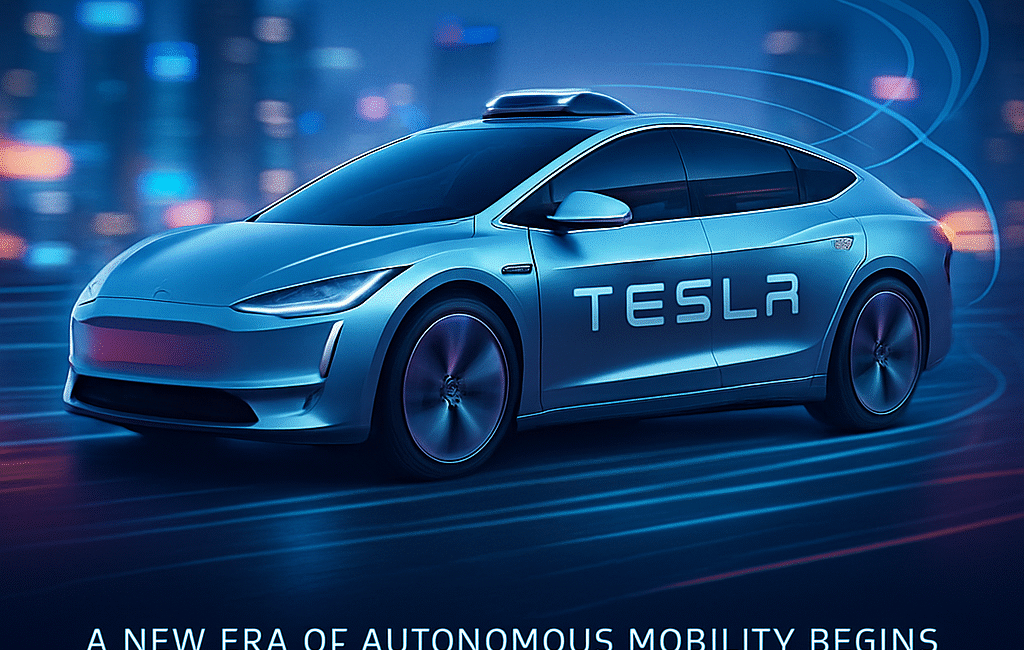
Tesla has once again redefined the future of mobility with the official launch of its Robotaxi service, signaling a bold leap into fully autonomous transportation. Announced by Elon Musk with characteristic flair, the Tesla Robotaxi is not just a new product—it’s a transformative shift for the global automotive and tech industries.
With this groundbreaking innovation, Tesla enters the race to commercialize autonomous vehicles, setting new standards for urban commuting, sustainability, and AI-driven transportation.
What is the Tesla Robotaxi?
The Tesla Robotaxi is a fully autonomous electric vehicle (EV) designed to operate without human intervention. Unlike traditional ride-sharing services that depend on human drivers, Tesla’s Robotaxi fleet will use the company’s Full Self-Driving (FSD) technology to navigate city streets, highways, and complex urban environments entirely on its own.
This ride-hailing model leverages Tesla’s existing electric vehicles, especially the Model 3 and Model Y, upgraded with FSD hardware and software to operate as Level 4 or Level 5 autonomous vehicles. Owners of eligible Teslas will be able to add their vehicles to the Robotaxi network and earn revenue passively, redefining the notion of car ownership.
Full Self-Driving (FSD) at the Core
At the core of Tesla’s Robotaxi system is its Full Self-Driving platform, a continuously evolving neural network trained on billions of real-world driving miles. Unlike competitors using LiDAR and pre-mapped geofencing, Tesla relies solely on vision-based AI, powered by cameras and Tesla’s proprietary Dojo supercomputer.
This vision-first approach enables the Robotaxi to function more similarly to human drivers—perceiving, predicting, and acting in real time. The FSD suite features:
- Navigate on Autopilot
- Auto Lane Change
- Autopark
- Summon
- Traffic Light and Stop Sign Control
- City Streets Navigation
With Tesla’s relentless software updates, each Robotaxi becomes smarter and safer over time, thanks to fleet learning and over-the-air (OTA) improvements.
Key Features of the Tesla Robotaxi
Tesla’s Robotaxi promises an intelligent and seamless ride experience. Key features include:
- Driverless operation: No need for a driver—users summon a vehicle via the Tesla app.
- Affordable pricing: Elon Musk claims the Robotaxi ride could cost less than a bus ticket.
- Sustainable transport: 100% electric with zero emissions.
- Custom-designed interior: Future versions may feature steering wheel-free designs for increased passenger space.
- 24/7 operation: Autonomous driving means no fatigue, no shifts—just continuous service.
- Enhanced Safety: Advanced AI with real-time hazard prediction, collision avoidance, and emergency handling.
These features combine to deliver a futuristic, safe, and cost-effective mobility solution, making Tesla a front-runner in next-gen transportation.
Economic Implications and Industry Disruption
The Tesla Robotaxi is poised to disrupt not just the automotive industry, but entire economic sectors, including:
- Ride-Hailing Services: Companies like Uber and Lyft face a seismic shift as Tesla cuts out the driver and slashes operational costs.
- Car Ownership Models: With the option to deploy personal Teslas in the Robotaxi network, owners can earn passive income, possibly eliminating the need for private car ownership altogether.
- Urban Planning and Infrastructure: Cities may adapt to reduced parking needs, dynamic routing, and improved traffic flows.
- Insurance and Liability: Autonomous vehicles will challenge traditional car insurance models, shifting responsibility from driver to manufacturer.
Tesla’s ecosystem could become a multi-trillion-dollar opportunity, merging auto manufacturing, software, and ride-sharing into one vertically integrated platform.
Tesla’s Competitive Advantage
Tesla holds significant advantages over its competitors in the Robotaxi race:
- Vertical Integration: Tesla designs its own chips, builds its own batteries, develops its own AI, and controls its entire supply chain.
- Massive Data Collection: With millions of Tesla vehicles on the road, each trip generates invaluable training data for its AI models.
- Dojo Supercomputer: Built specifically to train Tesla’s neural networks, Dojo offers unmatched AI processing power.
- Brand Loyalty and Ecosystem: With a loyal fanbase and cross-platform synergy (Solar, Powerwall, Tesla App), Tesla is uniquely positioned to dominate the Robotaxi space.
These strengths ensure that Tesla’s Robotaxi will not be a short-lived experiment, but a long-term, scalable business model.
Timeline and Availability
Although Elon Musk has previously set ambitious targets, the Robotaxi rollout is now on track. As of 2025, Tesla is:
- Testing fleets in major cities
- Rolling out regulatory-compliant FSD updates
- Preparing purpose-built Robotaxi vehicles with no steering wheels
- Partnering with governments for legal and safety frameworks
Initial deployment is expected in high-density urban areas in the United States, with gradual expansion into global markets as regulatory environments evolve.
Challenges and Roadblocks Ahead
While the potential is massive, Tesla still faces challenges:
- Regulatory Hurdles: Governments must adapt laws for autonomous vehicles.
- Public Trust: Convincing passengers to ride in a driverless car requires strong safety records.
- Technical Edge Cases: FSD must master unpredictable environments—weather, pedestrians, emergency vehicles.
- Cybersecurity: Autonomous systems must be resistant to hacking and interference.
Tesla continues to address these obstacles through transparent safety data, iterative FSD updates, and ongoing collaboration with public agencies.
How the Tesla Robotaxi Will Change Daily Life
From commuting to logistics, the Tesla Robotaxi will reshape daily routines:
- No more designated drivers on a night out.
- Reduced car-related expenses: gas, insurance, maintenance.
- Lower emissions and cleaner cities.
- Greater access to mobility for non-drivers, elderly, or disabled.
- Flexible and on-demand transport, eliminating wait times and scheduling hassles.
With Tesla Robotaxi, transportation becomes a smart, efficient, and on-demand utility, much like electricity or the internet.
Conclusion: The Autonomous Revolution Has Begun
The launch of Tesla’s Robotaxi marks the beginning of a paradigm shift in transportation. This isn’t just a new car—it’s the evolution of how we move, live, and interact with our cities. Backed by Tesla’s relentless innovation and engineering might, Robotaxi is poised to dominate the future of autonomous mobility.