


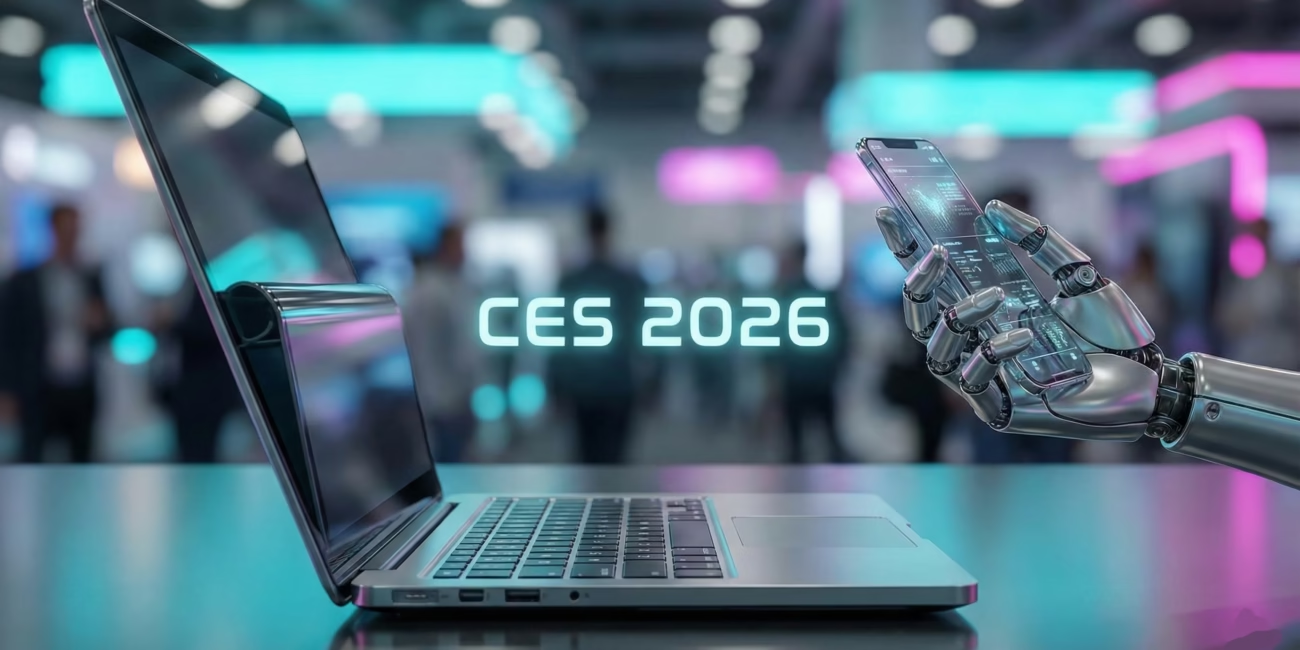
CES 2026 Recap: Moving Beyond the Hype to Real-World Utility
If you’ve followed the Consumer Electronics Show (CES) for as long as I have, you know the drill. Every January in Las Vegas, we’re bombarded with flashy gadgets that look great on stage but often vanish before they hit the shelves. But walking through the halls this year, something felt different. CES 2026 wasn’t just about “look at this cool thing”—it was about “here is how this fits into your actual life.”
We are seeing a massive shift where technology is becoming less intrusive and more supportive. From screens that unroll only when you need them to AI that monitors your emotional health without a screen at all, this year’s tech innovations are prioritizing utility over novelty.
Here is a breakdown of the real game-changers from the show and what they tell us about the future of consumer tech.
The Era of “Invisible” AI
For years, we’ve been glued to smartphones. But if CES 2026 proved one thing, it’s that the industry is trying to get us to look up. The trend now is “ambient computing”—devices that work in the background.
Emotional Intelligence on Your Wrist
One of the most fascinating developments is the move away from screen-heavy smartwatches. Devices like the Luna Band by Noise and the Nirva AI Wearable are stripping away the display entirely.
In practical use, this solves a huge problem: notification fatigue. Instead of constantly buzzing your wrist with emails, these devices use advanced sensors to track metrics we usually ignore, like emotional stress and circadian rhythms. The Nirva, specifically, frames itself as an “emotion tracker.” It’s a bold move, but it signals that the future of wearables isn’t about productivity—it’s about wellness and mental health.
The Holographic Desk Assistant
On the flip side, we have Razer’s Project AVA. While many AI assistants are just voice bots, AVA gives the AI a face (literally). By using a holographic display, it creates a sense of presence. It might sound gimmicky, but for remote workers who spend hours alone, having an interactive, visual “companion” that can help with brainstorming or gaming strategy adds a layer of social connection that text chatbots lack.
Displays That Adapt to You
We used to buy screens based on where they would fit on our desks. Now, the screens are adapting to fit us.
The standout here is the Lenovo Legion Pro Rollable Laptop. We’ve seen flexible screens before, but this application is genuinely useful. The ability to push a button and expand your workspace from a standard 16-inch laptop to a massive 24-inch ultrawide monitor is a dream for editors and gamers.
Similarly, the ASUS ROG Zephyrus Duo 2026 is pushing the dual-screen envelope. In real-world scenarios, having two full OLED panels allows for a multitasking setup that usually requires a clunky external monitor. It’s clear that the rigid, single-screen laptop era is ending.
Sustainable Power is the New Luxury
Sustainability is often a buzzword thrown around at CES, but this year brought hardware that actually reduces grid reliance.
Harvesting Indoor Light
One of the quieter but potentially most impactful tech innovations is Dracula Technologies’ LAYER V2.0. It’s an organic photovoltaic technology that harvests energy from indoor light.
Think about what this means for the smart home. We currently have dozens of sensors and remotes that need battery changes. If this tech scales, we could see a future where your IoT devices never need a battery swap because they run entirely on the light from your living room lamps.
The Off-Grid Gazebo
On the macro scale, the Jackery Solar Gazebo turns a backyard structure into a power plant. By integrating solar panels directly into the roof of a gazebo, it generates enough power to run a household during an outage. This reflects a growing consumer desire for energy independence—people don’t just want green tech; they want security.
Robotics: Science Fiction Becoming Affordable
We usually see robots at CES that cost as much as a house. This year, the Unitree Robotics G1 shocked everyone with a price point under $16,000.
While that’s still expensive for a toy, it’s incredibly cheap for a fully functional humanoid robot. It suggests we are crossing a threshold where general-purpose robotics might actually become viable for small businesses or serious researchers, rather than just mega-corporations.
What This Means for Consumers
Looking at the landscape of technology presented this year, the theme is “integration.”
- Audio is modular: The Fender Mix headphones let you swap out parts, extending the device’s lifespan.
- Lighting is spatial: Philips Hue is using AR to map lights to your specific room layout, making smart homes feel less robotic and more organic.
- Computing is hybrid: ChatQLM is trying to bring quantum computing to consumers via a chat interface.
The takeaway from CES 2026 isn’t just about faster processors or brighter screens. It’s about hardware that lasts longer, adapts to our physical environments, and understands our biological needs. If these trends hold, the next few years of tech will be less about distracting us and more about supporting us.

Other Articles

Notepad++ Security Alert: Understanding the 6-Month Backdoor Breach
