
For decades, the battle between students and examiners was a game of hidden scraps of paper, notes scribbled on palms, or complex codes hidden inside calculator covers. However, as we move further into 2026, the playing field has shifted from physical paper to high-tech silicon. The rise of AI smart glasses has introduced a challenge that schools and universities were largely unprepared for, turning a tool designed for productivity into a sophisticated method for cheating students.
In this deep dive, we will explore the technology behind these devices, why they are so difficult to detect, and how the education system is attempting to pivot in a world where wearable tech beat exams before the proctor even says “begin.”
Understanding the Shift: From Screens to Spectacles
In real-world use, the transition from smartphones to wearable AI has been subtle. While a teacher can easily spot a student reaching for a phone under a desk, identifying a pair of glasses as a high-powered computer is much harder.
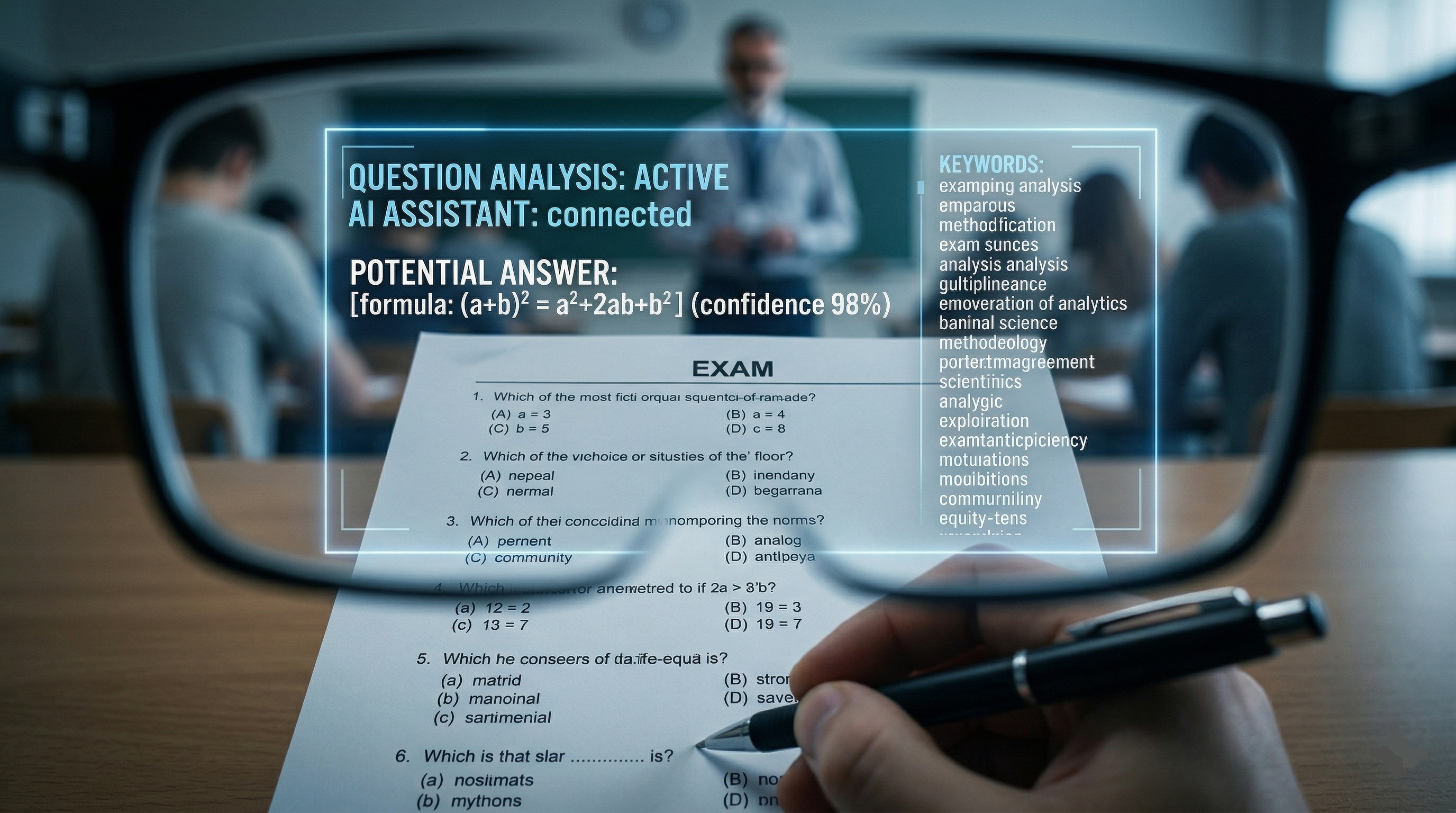
Modern AI smart glasses are no longer the bulky, glowing prototypes of a decade ago. Today’s models look identical to standard prescription eyewear or popular designer sunglasses. They house micro-cameras, bone-conduction speakers, and heads-up displays (HUDs) that are invisible to anyone not wearing them.
How the Technology Functions in a Classroom
From practical experience, the process of using these devices for academic dishonesty usually follows a specific technical logic:
- Image Capture: A pinhole camera embedded in the frame “sees” the exam paper.
- OCR Processing: Optical Character Recognition (OCR) software converts the image of the text into data.
- AI Query: This data is sent to a Large Language Model (LLM)—like a specialized version of GPT or Claude—which generates the answer in seconds.
- Discreet Feedback: The answer is then projected onto the lens via a tiny prism or whispered into the student’s ear through vibrations in the temple of the glasses (bone conduction).
Why Cheating Students are Turning to Wearables
Many users notice that the pressure of modern education often drives students toward extreme measures. The “all-or-nothing” nature of high-stakes testing, combined with the accessibility of powerful AI, has made the risk of cheating seem worth the reward for some.
The Problem of “Seamlessness”
The primary appeal of AI smart glasses is that they don’t require the user to change their behavior. To an outside observer, a student is simply staring at their paper, thinking. In reality, the student is reading a scrolling teleprompter of answers overlaid on their field of vision. This lack of physical “tells” makes traditional invigilation almost obsolete.
The “Always-On” Assistance
Unlike a hidden note, which is static, AI is dynamic. If a question is phrased in a way the student doesn’t understand, the AI can rephrase it, provide a step-by-step breakdown of a math problem, or even suggest a counter-argument for an essay—all in real-time. This is why many claim that wearable tech beat exams not just by providing answers, but by providing a superior cognitive “crutch.”
The Technical Gap: Why Schools Struggle to Stop It
From a researcher’s perspective, the struggle for academic institutions isn’t just a lack of effort; it’s a technological mismatch. Most exam halls are designed to catch analog threats, not digital ones.

1. The Optical Illusion
Detecting a heads-up display from a distance is nearly impossible. Unless a proctor is looking at the lens from a specific angle under specific lighting, the projection remains invisible. Furthermore, because many students genuinely require prescription glasses, a blanket ban on eyewear is a logistical and accessibility nightmare.
2. Connectivity Issues
While some schools use signal jammers (where legal), many modern smart glasses can operate on low-power Bluetooth or even store data locally. If a student downloads a lightweight AI model directly onto the device’s internal storage, “cutting the internet” doesn’t stop the cheating.
3. The Miniaturization of Hardware
We are now seeing “smart contact lenses” entering the early stages of testing. As the hardware continues to shrink, the task of detecting ai smart glasses will seem easy compared to what comes next.
Logical Reasoning: Is the Problem the Tech or the Test?
If we analyze this trend honestly, we have to ask a difficult question: Is the technology the problem, or is it the way we test knowledge?
In the real world, no professional is forbidden from using tools. A doctor uses diagnostic software; an engineer uses CAD and simulation tools. By forcing students into a “vacuum” for three hours to test their memorization, we are creating a scenario that exists nowhere else in life. This disconnect is exactly where the temptation to use wearable tech beat exams originates.
The Shift Toward “AI-Resistant” Assessment
Many educational experts are beginning to argue for a change in how we measure intelligence. Instead of “closed-book” exams where AI can easily provide the answers, schools are exploring:
- Oral Examinations: Where a student must explain their reasoning in a live conversation.
- Applied Projects: Where the process and the “why” are graded rather than just the final “what.”
- In-Class Simulations: Where students use AI tools openly, but are graded on how they prompt, verify, and improve the AI’s output.
Practical Steps Schools are Taking Now
Despite the long-term need for reform, schools still have to manage academic integrity today. From practical experience, here are the methods currently being deployed:
High-Tech Detection
Some universities are investing in “glint detection” software. These are specialized cameras that scan the room for the specific infrared or LED reflections produced by smart glass displays. While expensive, they offer a way to identify active electronics without physical searches.
Strict Eyewear Policies
In some high-security testing centers, students are required to place their glasses in a “lens scanner” before entering, or they are provided with “standardized” non-smart glasses if their prescription allows. However, this is difficult to scale for thousands of students.
Behavioral Analysis
Proctors are being trained to look for “non-natural” eye movements. A student using a heads-up display often has a specific “tracking” gaze—their eyes move across the lens rather than across the paper.
The Ethical Dilemma: Accessibility vs. Integrity
There is a gray area that we must address. For students with certain learning disabilities, AI smart glasses can be a legitimate accessibility tool. They can read text aloud for students with dyslexia or provide visual cues for those with hearing impairments.
The challenge for educators is distinguishing between a student using a device to “level the playing field” and a student using it to “bypass the field entirely.” Without clear guidelines, we risk penalizing students who rely on wearable tech for genuine medical or cognitive support.
Final Thoughts: A Future of Co-Existence
The reality is that ai smart glasses are not going away. Like the calculator and the laptop before them, they will eventually become a standard part of our daily lives. The current wave of cheating students is a symptom of a transition period where our technology has advanced faster than our social and educational structures.
While it is true that wearable tech beat exams in the short term, the long-term solution isn’t a bigger wall or more detectors. It is a fundamental rethink of what “knowing” something actually means in 2026.
From a researcher’s perspective, the goal shouldn’t be to win a “tech war” against students, but to create an environment where the tech is a partner in learning, not a shortcut to a grade. Until then, the invisible battle in the exam hall will continue, one pair of glasses at a time.